


Why Commercial Land Valuation Is Important Before Buying or Selling Development Land
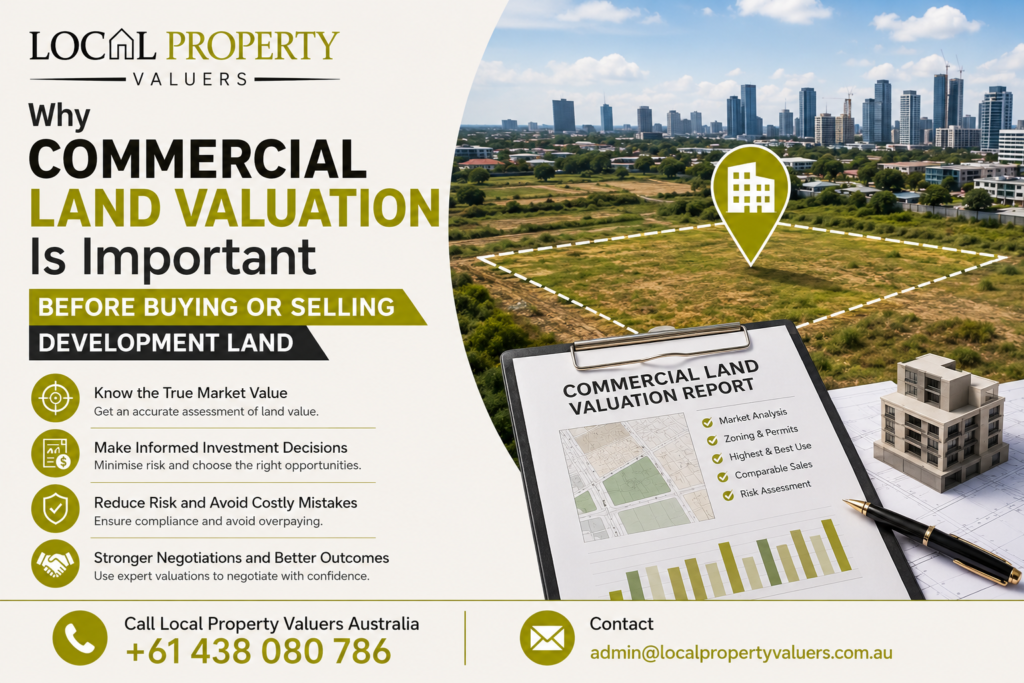
Most property buyers and sellers think about valuation in terms of bricks and mortar. the building, the fit-out, and the rental income. But when it comes to development land, it is the ground itself that carries the value. Understanding what that land is genuinely worth before entering a transaction is therefore one of the most important steps any buyer, seller, or developer can take.
A professional commercial land valuation is a specialist process that goes well beyond reviewing recent comparable sales. It considers zoning controls, planning permissions, infrastructure contributions, development yield potential, site constraints, and current market demand for land of that type and location. Without an independent, properly prepared assessment, both buyers and sellers risk agreeing to a price that does not reflect the site’s true commercial potential.
SUMMARY
What This Article Covers This guide explains what a commercial land valuation measures and how it differs from a standard improved property valuation. It covers why an independent assessment is critical before purchasing or selling development land, what factors drive commercial land value across Australian markets, how zoning and planning controls affect site value, the legal and compliance contexts where certified land valuations are required, and how land tax objections and compulsory acquisition matters depend on accurate independent evidence. Eight concise FAQs address the most common questions from buyers, sellers, developers, and their advisers.
What a Commercial Land Valuation Actually Measures
A commercial land valuation is a formal, independent assessment of the market value of a parcel of land used for or suitable for commercial, industrial, or mixed-use development. It is prepared by a Certified Practising Valuer who is a member of the Australian Property Institute and has specialist expertise in the commercial and development land market. The report establishes what a willing buyer would pay and a willing seller would accept in an open, arm’s length transaction, with both parties fully informed of the site’s planning controls, development constraints, and market conditions.
What makes commercial land valuation genuinely complex is that the value of the land is inseparable from its potential. A site zoned for high-density residential development in an inner suburban corridor of Sydney, Melbourne, or Brisbane has a very different value proposition than a comparably sized industrial site in a suburban fringe location, even if the two parcels share a similar area or geographic proximity. The valuer’s job is to understand and quantify that potential within a framework of current market evidence.
Site Value and What It Means in Practice
Site value is the value of the land in its unimproved state, without regard to any existing structures. This is a distinct concept from the value of a property as a whole, which includes the improvements. For development land transactions, site value is the operative figure because buyers are typically acquiring the land for what they can do with it, not for what currently sits on it. An existing building on a development site may in fact have negative value if it needs to be demolished before the new development can commence, and a commercial land valuation will take that demolition cost into account.
Commercial Land vs Improved Commercial Property
An improved commercial property valuation assesses the market value of land plus buildings, considering rental income, lease terms, capitalisation rates, and the physical characteristics of the structure. A commercial land valuation strips away the improvement component and focuses entirely on the land’s underlying potential. The methodologies are different, the comparable evidence used is different, and the factors that drive value are different. Applying an improved property valuation methodology to a development site, or treating a land valuation as equivalent to an improved property assessment, produces an unreliable figure that serves neither buyer nor seller well.
Why Buyers Need a Commercial Land Valuation Before They Purchase
Purchasing commercial development land without an independent valuation is one of the higher-risk decisions a buyer can make. The asking price on a development site reflects the vendor’s expectations, the agent’s assessment, and the market conditions at the time of listing. None of those three things is an independent, certified opinion of what the land is genuinely worth.
Checking the Asking Price Against Market Evidence
A certified commercial land valuation gives the buyer an objective reference point before negotiations begin. It draws on comparable land sales in the area, adjusts for differences in site area, zoning, frontage, shape, and development constraints, and produces a concluded market value supported by evidence the buyer can assess and rely upon. Where the asking price is above the certified value, the buyer has the information they need to negotiate with confidence. Where the certified value supports the asking price, the buyer proceeds with genuine confidence rather than optimistic assumption.
This matters particularly in thinly traded markets where comparable sales are few and agent appraisals are doing more interpretive work than the evidence base really supports. Commercial land in growth corridors on the outskirts of Sydney, Melbourne, Brisbane, and the Gold Coast has in recent years been subject to significant speculation, and asking prices in some precincts have moved ahead of the evidence. An independent commercial land valuation anchors the buyer’s position in reality.
Understanding Development Potential and Highest and Best Use
A commercial land valuation for acquisition purposes also assesses the site’s highest and best use. This is the legal, financially feasible, and maximally productive use that the site is physically capable of supporting. For a site in a commercial zone with significant floor space ratio, the highest and best use might be a multi-level commercial or mixed-use development. For an industrial site with large site area and good vehicle access, it might be a logistics or warehousing facility. Understanding the highest and best use is what allows the buyer to assess whether the acquisition price is justified by the development program the site can support.
Why Sellers Need a Commercial Land Valuation Before Going to Market
Vendors who list commercial development land without an independent valuation risk one of two outcomes. They price too low, transacting below market value and leaving money on the table. Or they price too high, sitting on the market while informed buyers with their own valuation evidence dismiss the property as overpriced. Neither outcome serves the vendor’s interests, and both can be avoided with a certified commercial land valuation before listing.
Anchoring the Asking Price in Evidence
A well-prepared commercial land valuation report gives the vendor and their agent a defensible starting position for price negotiations. When a buyer argues for a lower price, the vendor can point to an independent, professionally prepared assessment that supports the asking figure. That creates a very different negotiating dynamic than a vendor relying solely on their agent’s market appraisal, which a sophisticated buyer on the other side of the table will quickly recognise as a document produced for marketing rather than for independent evidence.
Tax Implications on Land Sales
Selling commercial land triggers capital gains tax on the difference between the cost base and the net proceeds. When the land was acquired some years ago, establishing the correct cost base requires an accurate historical market value, and when any aspect of the acquisition or intervening ownership involved a related party transaction or a change of use, the Australian Taxation Office may apply the market value substitution rule under the Income Tax Assessment Act 1997. A certified commercial land valuation at the appropriate historical date gives the vendor the ATO-compliant evidence they need to support the cost base used in the capital gains calculation.
Similarly, transfer duty in NSW and equivalent duties in other states are assessed on the higher of the purchase price or the market value of the land being transferred. In arm’s length open market sales, the purchase price is generally accepted. In related-party, non-monetary or otherwise non-arm’s-length transactions, or where the consideration does not appear to reflect the property’s unencumbered value, an independent valuation may provide the market value evidence Revenue NSW requires.
What Drives Commercial Land Value Across Australian Markets
Commercial land value is determined by a combination of planning controls, location, market demand, and the specific characteristics of the site. Understanding which of these factors carries the most weight in a particular market is what distinguishes a specialist commercial land valuer from a generalist.
Zoning and Planning Controls
Zoning is one of the most powerful value drivers for commercial development land. A site zoned for mixed-use development in an activity centre, a high density residential zone in an inner city corridor, or a strategic industrial zoning in a designated employment land precinct each carries a dramatically different value profile than land in a lower intensity zone. Under the Environmental Planning and Assessment Act 1979 in NSW and equivalent planning legislation in other states, the floor space ratio, building height limits, setbacks, and permissible uses all constrain or enable the development program the site can support, and the commercial land valuation must account for every one of those controls.
Location, Access and Infrastructure
Commercial land in close proximity to transport infrastructure, motorway interchanges, rail stations, port facilities, and airport precincts attracts a premium that reflects the operational advantages those locations provide for businesses and developers. Industrial land in established logistics precincts near Sydney’s M7 corridor, along Melbourne’s Outer Ring Road, or in South East Queensland’s trade gateways commands significant premiums over comparable sites in more remote locations. A commercial land valuation must reflect those locational advantages accurately rather than applying a uniform rate to all sites in a broad geographic area.
Legal and Compliance Situations Requiring an Independent Land Valuation
Commercial land valuation is required in several legal and regulatory contexts beyond the straightforward purchase or sale transaction. In each of these situations, the certified valuation report is the foundational document on which a significant decision or outcome depends.
Land Tax and Valuation Objections
In NSW, the Valuer General issues annual land value assessments that form the basis for land tax liability. Where a landowner believes the assessed land value is above genuine market value, a formal objection can be lodged within the statutory timeframe. An independent commercial land valuation prepared by a Certified Practising Valuer, supported by comparable land sales evidence from around the relevant valuation date, is the evidence base for a successful objection. The same process applies in Victoria, Queensland, South Australia, and Western Australia, where state revenue authorities assess land tax on government valuations that landowners can challenge with independent evidence.
Compulsory Acquisition and Easement Compensation
When a government authority, council, or utility acquires commercial land or registers an easement over it, the compensation payable to the landowner is assessed by reference to the market value of the land or the diminution in its value caused by the easement. Under the Land Acquisition (Just Terms Compensation) Act 1991 in NSW and equivalent legislation in other states, the landowner is entitled to market value compensation, and a certified independent commercial land valuation from a Certified Practising Valuer establishes that entitlement with the professional authority needed to support a negotiation or a formal claim.
Key Situations Where a Certified Commercial Land Valuation Is Required
• Before acquiring development land to verify the asking price against genuine market evidence
• Before listing commercial land for sale to establish a credible, evidence-based asking price
• For capital gains tax compliance when a land disposal event is triggered
• For stamp duty and transfer duty compliance in related party or non-arm’s length transactions
• For land tax objections where the Valuer General’s assessment exceeds market value
• For compulsory acquisition compensation claims under just terms legislation
• For SMSF compliance where the fund is acquiring or holding commercial land
• For family law settlements where development land forms part of the property pool
Frequently Asked Questions
Q: What is a commercial land valuation?
A: A commercial land valuation is a formal independent assessment of the market value of land used for or capable of being used for commercial, industrial, or development purposes. It is prepared by a Certified Practising Valuer and considers zoning controls, development potential, comparable land sales, and current market conditions to establish a defensible, evidence-based market value.
Q: Why is a commercial land valuation different from a commercial property valuation?
A: A commercial property valuation assesses the market value of the land and any existing improvements together. A commercial land valuation assesses the value of the land itself, treating existing structures as potentially incidental or even requiring demolition. For development sites, the land value is what drives the transaction, and the valuation methodology reflects that focus.
Q: When should I get a commercial land valuation before buying development land?
A: Before you make an offer or commit to a contract. A certified commercial land valuation gives you an independent view of what the site is worth based on market evidence, not the vendor’s asking price or the agent’s appraisal. It also assesses the site’s development potential and highest and best use, which are critical inputs to any development feasibility analysis.
Q: Does selling commercial land trigger capital gains tax?
A: Yes. A sale of commercial land is a capital gains tax event, and the gain is calculated on the difference between the cost base and the net sale proceeds. A certified commercial land valuation at the original acquisition date or at any relevant historical date establishes the cost base with the documented evidence the ATO requires.
Q: Can I challenge the Valuer General’s land tax assessment with a commercial land valuation?
A: Yes. In NSW and most other Australian states, you can lodge a formal objection to the government land value assessment within the relevant statutory timeframe. A certified independent commercial land valuation supported by comparable land sales evidence from around the valuation date is the foundation of a successful objection.
Q: What factors most affect commercial land value?
A: Zoning and permitted uses, floor space ratio and building height allowances, site area and dimensions, proximity to transport and infrastructure, market demand for the development type the site can support, and local supply conditions for comparable commercial land in the area. Each of these is assessed by the valuer in the context of the specific market where the land is located.
Q: Do I need a separate land valuation if I already have an improved property valuation?
A: For development purposes, yes. An improved property valuation captures the value of land and buildings together using a methodology suited to the income stream or sale value of the existing property. A commercial land valuation specifically addresses the development potential of the land, which requires different comparable evidence and a different analytical approach.
Q: Does Local Property Valuers cover commercial land valuations outside Sydney?
A: Yes. Local Property Valuers provides certified commercial land valuation reports across Australia, including Sydney, Melbourne, Brisbane, Gold Coast, Perth, Adelaide, Darwin, and regional and rural markets. Their network of locally experienced Certified Practising Valuers ensures the comparable evidence and market analysis reflects the specific location of each site.
CONCLUSION
Commercial land valuation is not a formality that can be skipped or substituted with an agent’s market appraisal. For buyers, it is the evidence base that keeps a transaction anchored in reality. For sellers, it is the foundation of a credible asking price. For developers, investors, and anyone with a compliance obligation, it is the certified, independent document that satisfies lenders, courts, the ATO, and state revenue authorities.
Getting a commercial land valuation right, from a Certified Practising Valuer with genuine experience in development and commercial land markets, is what separates good decisions from expensive ones.
Need a commercial land valuation? Contact Local Property Valuers
Local Property Valuers provides certified, independent commercial land valuation reports for development sites, industrial land, and retail and commercial sites across Sydney, Melbourne, Brisbane, the Gold Coast, Perth, Adelaide, Darwin, and Australia-wide. API accredited. Fixed price. Trusted by buyers, sellers, developers, and legal advisers. Request a quote online today.
Visit localpropertyvaluers.com.au | Request a Quote | Australia-Wide Coverage